


Case
RACE
Applying AI and Real-Time computing in the Energy Sector
The RACE solution
Real-Time AI Computing in the Energy Sector
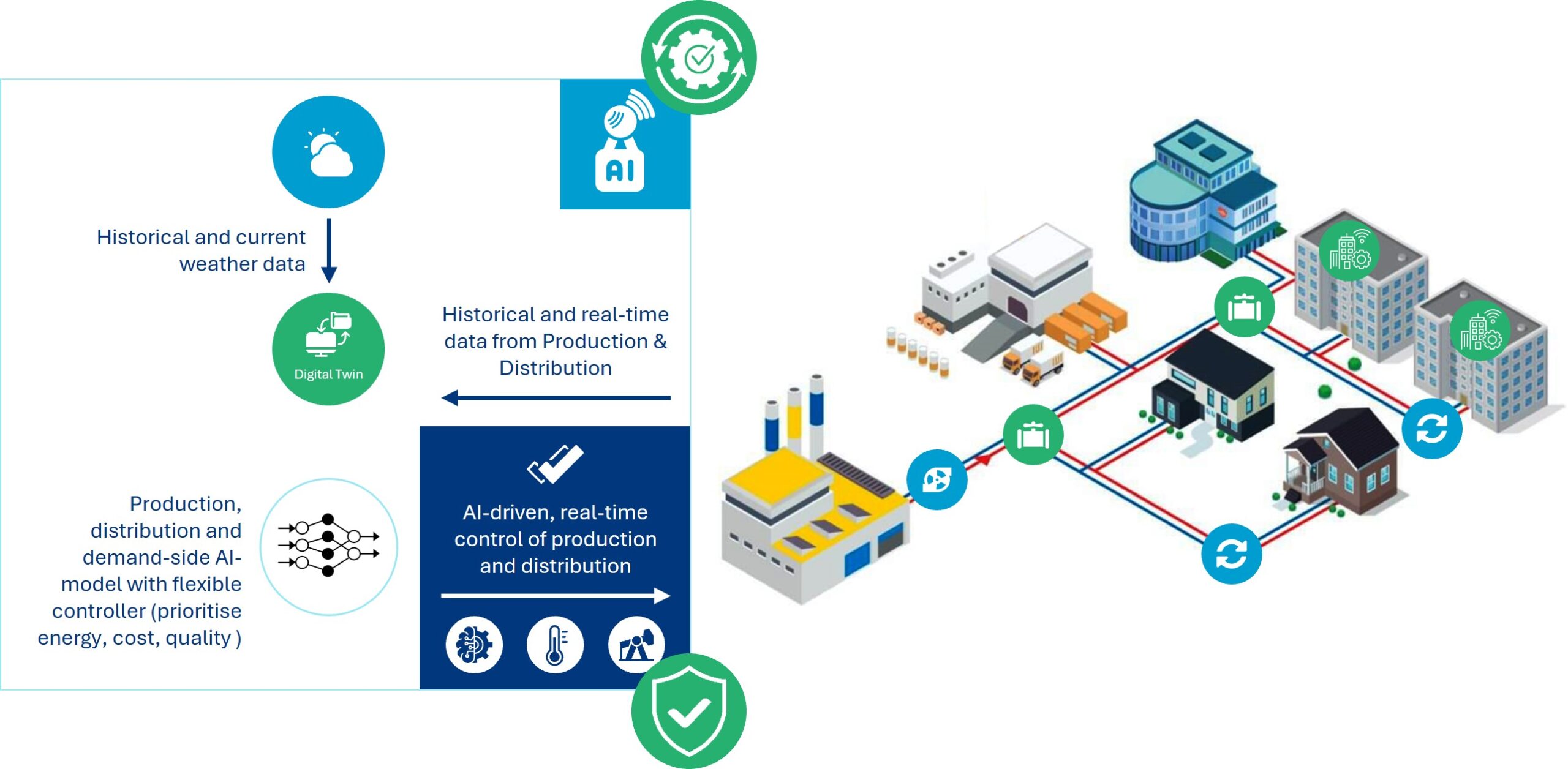
Glaze and Beacon Tower has together with Energy Cluster Denmark, Develco, Brønderslev Forsyning A/S, Broen A/S and Aalborg University Distributed, Embedded and Intelligent Systems & Civil Engineering developed a solution for tomorrow’s district heating systems. The project has been funded by EUDP.
Overview
The joint RACE (Real-time AI Computing in the Energy sector) project has successfully transitioned from a visionary prototype to a validated, commercial-ready solution for autonomous district heating optimisation. By integrating a predictive digital twin with real-time data from across the entire network, the system achieves significant energy savings through automated “closed loop” control.
How the AI Works: Learning and Digital Twins
The AI component consists of three integrated elements designed to adaptively manage the complexities of the heating network:
-
The Physical Digital Twin: A mathematical-physical model of the pipe network that calculates pressure and temperature conditions in real-time. It is continuously calibrated against live measurement data. A core design principle is that the mathematical model is highly robust against incomplete telemetry and self-calibrates over time. Rather than attempting to build a perfectly flawless theoretical simulation of the grid, the system uses data-driven system identification to extract actionable intelligence from historical data.
-
Prognostic Neural Networks: To achieve high accuracy, these models forecast future heat demand based on a combination of historical data, weather forecasts, and time patterns (seasonality and time of day).
-
Self-Learning Controller: The system utilises an advanced Model Predictive Control framework. Within this framework, a specialised neural network for optimisation uses the digital twin and the demand forecast to simulate various operational scenarios and select the optimal setpoints. This optimisation operates at a resolution of approximately 4 minutes, placing the solution firmly in the near-real-time category. The selected setpoints are then transmitted directly to the customer’s SCADA system for actual operational execution.
Rapid Deployment and Scalability
A fundamental design principle of RACE is that the solution can be deployed rapidly without the need for exhaustive preliminary studies or bespoke adaptations. Because the AI relies on data-driven system identification rather than perfect theoretical models, deployment is vastly simplified, and the risk of inaccurate grid documentation limiting the solution’s functionality is heavily reduced.
We have verified and generalised this data-driven system identification, ensuring that onboarding new customers is a streamlined process rather than an isolated, bespoke development project.
Business and Optimisation Benefits: Beyond Energy Savings
RACE provides a comprehensive business case that extends beyond energy reduction (5-10% of total energy production), drawing on successful real-world implementations:
-
Infrastructure Longevity: By maintaining lower and more stable grid pressure, the system significantly reduces wear and tear on the pipe network and components, extending the overall lifespan of the infrastructure.
-
Significant CAPEX Savings: AI-driven balancing allows utilities to maximise the capacity of existing pipes. This can result in up to 50% savings on future capital expenditures (CAPEX) for network expansions by avoiding costly pipe upgrades through smarter utilisation.
-
Surplus Heat Integration: The system can integrate real-time data from surplus heat contributors, such as data centres and supermarkets. This allows the plant to optimise its production mix in real-time based on available excess heat, further reducing costs and CO2 emissions.
-
Operational Resilience: The architecture provides a critical independent data path functioning as a redundant system. If the primary SCADA system experiences outages or cyberattacks, operations can still access real-time data directly via the Beacon Tower portal.
-
Rapid ROI: Estimated simple payback times for RACE implementations range from 1.9 to 2.8 years, making it a highly attractive commercial investment.
The Role of HydroState: Real-Time “Eyes” in the Network
Traditional networks often operate based on assumptions. HydroState provides the “ground truth” through patented sensors delivering real-time pressure, temperature, and flow data from strategic points. These sensors act as the “eyes” of the AI, providing the high-resolution feedback required to safely lower temperatures and pressures without risking supply failure or cavitation.
Beacon Tower: The Data Orchestrator and Resiliency Anchor
Beacon Tower is central to the RACE architecture for several key reasons. Firstly, it stores both real-time and historical telemetry in a unified manner – a critical capability that traditional SCADA systems often lack. Secondly, it serves as the secure bi-directional communication DataOps engine that allows AI-calculated optimisations to be executed instantly on the local OT infrastructure.
Crucially, Beacon Tower is architecturally designed to be deployed in the cloud, locally (on-premise), or as a hybrid setup. This flexibility enables RACE to meet the varying data sovereignty demands of different customers.
Strategic Advantages
-
Data Sovereignty and Local Deployment: We have further developed RACE so that it will be able to run entirely locally on the customer’s premises without any dependencies on external cloud services. This opens the solution up to grid owners who are highly sensitive to security and data sovereignty (such as NIS2 compliance).
-
Independence from Big Tech: RACE relies on standard, high-performance programming rather than proprietary services from global tech and AI giants, ensuring utilities retain full control over their data.
-
Vendor Agnostic: The AI-solution works with any sensor or SCADA brand, eliminating vendor lock-in.
This is a project backed by EUDP – The Energy Technology Development and Demonstration Programme in Denmark. The project had a budget of appr. 12,6 M DKK.
More information
Are you interested in hearing more? Then feel free to contact Jakob Appel, Managing Partner at Glaze, at jakob.appel@glaze.dk or +45 26 17 18 58 for more information.